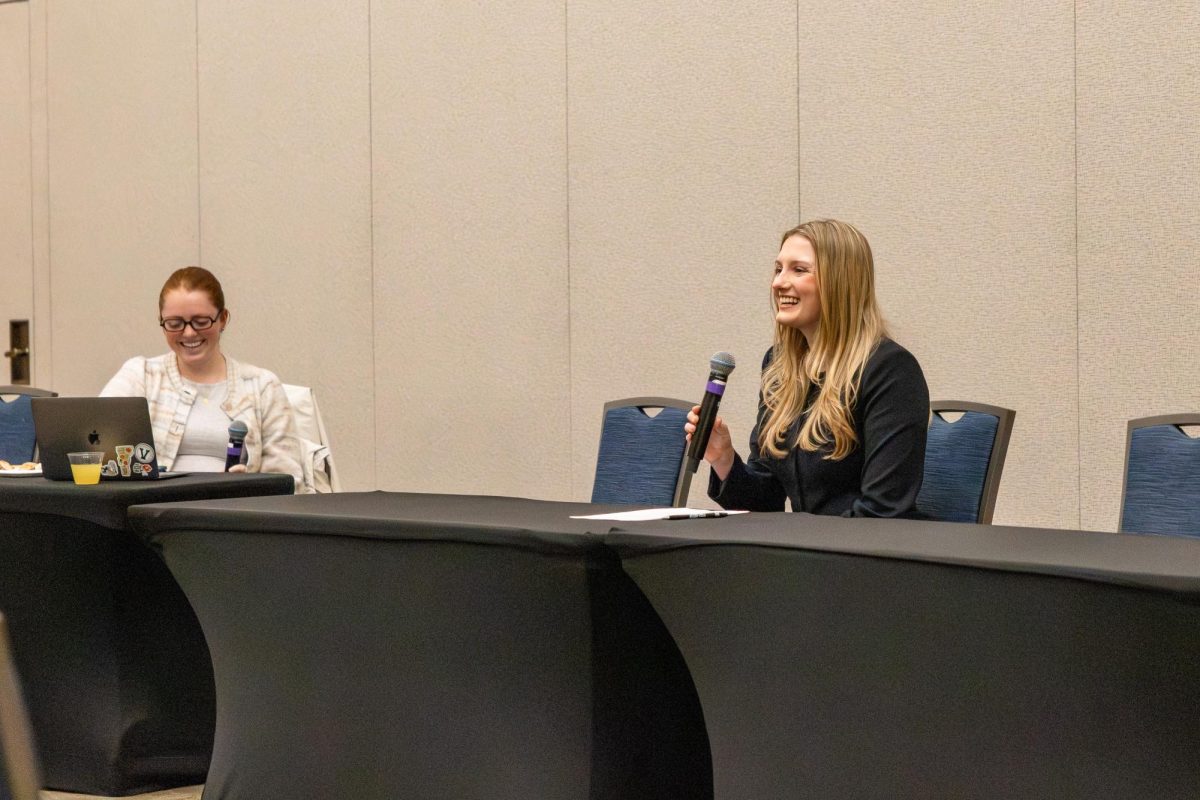


On March 24, the Abenaki of Odanak and Wôlinak reaffirmed their stance that they are the only true descendants of the Abenaki tribe in a presentation given during a UVM class.
The presentation took place in Natural Resources 1060: Race and Culture in NR and featured four Abenaki speakers who spoke about the tribe’s history and culture.
“We still are the true Abenaki people,” said Daniel Nolett, executive director of the Abenaki Band Council.
The Abenaki Nation as recognized by Quebec comprises over 2,000 members, with nearly 400 living in the reserves of Odanak and Wôlinak, according to their website. The Odanak and Wôlinak reserves are located northeast of Montreal.
Some of the speakers traveled from their homes on the Abenaki reserves at Odanak and Wôlinak in Canada, while others live off-reserve.
The lecturing team of NR 1060 invited the Abenaki of Odanak and Wôlinak. Lecturers Lucy Drummond and Kristian Brevik coordinated the visit, they said.
“We want to have the Abenaki presence in this course and as original people of this land discuss their priorities and their needs,” Drummond said.
Nolett began the presentation with a discussion of Abenaki history and culture, including their industry of basket making. The tribe frequently traveled to New England to sell the baskets to tourists during the late 19th and early 20th centuries, they said.
Denise Watso, founder of the Abenaki Cultural Preservation, discussed the tribe’s history with Indian residential schools in Canada, including her father’s experience at one that instilled in him feelings of guilt and shame over his identity.
“They were evil schools,” she said. “No one there to protect you as a child, no nurturing, malnourished, beatings for speaking your language, your hair shaved.”
The Abenaki of Odanak and Wôlinak have previously visited several courses in the Rubenstein School, Brevik said.
“[The lecturing team] felt it was important to invite Abenaki, who have been erased the past few decades and not included in other state activities, to really share their stories,” Drummond said.
At a 2022 panel, the Abenaki of Odanak and Wôlinak shared their view that Vermont’s state-recognized tribes are not Abenaki. While it was the first time they spoke about the issue on UVM’s campus, the tribe had first adopted this view in the 1990s, Nolett said.
“We have our responsibility as educators to engage with history and evidence,” Brevik said. “That led us to how we have chosen to teach this and who we’ve invited.”
Brevik said he hoped students would gain the necessary intellectual tools to understand and become fully informed on the Abenaki identity controversy.
“We are certainly not telling students what to think, but instead giving them as much information that they can have,” Brevik said. “All the evidence and history is supporting [the Abenaki of Odanak and Wôlinak].”
A genealogical study conducted by Darryl Leroux, an associate professor at the University of Ottawa, found that less than 3% of the Vermont-recognized tribes’ members descend from Abenaki people, according to a 2023 article. Most of their ancestors are French-Canadian.
“Those people only came to life [in] 1975,” Nolett said in his presentation. “Prior to this period, we never heard of anybody else but us occupying the territory. We did come back and roam our territory without ever meeting anybody from the so-called Abenaki groups of today.”
The four state-recognized tribes received state recognition in 2011 and 2012, according to the Vermont government’s website. Each tribe’s headquarters is located in a different part of the state, with locations in Swanton, Barton, Newbury and Brattleboro.
The state-recognized tribes claim to have been in hiding prior to the 1970s, but the Abenaki of Odanak and Wôlinak view that story as fiction, said Watso.
Conor Hawk Cubit, biological project manager for the Odanak Land and Environment Office, hopes the Abenaki’s visibility at UVM deromanticizes what it means to be indigenous. He believes that romanticization leads to gaps in understanding that the state-recognized tribes can exploit.
“To get students to be able to say, ‘Yeah, I know Abenaki people. They’re right there. I met them yesterday in my class,’ is huge,” Cubit said. “We’re coming back to re-close that gap, fix the appropriation [and] get to the truth of who we actually are.”
Nolett said he fears that the university itself will continue to work with the state-recognized tribes until their recognition is repealed.
Despite sending a request to meet, the University never met with the Abenaki of Odanak and Wôlinak following the 2022 panel.
“I’m afraid that the University of Vermont will hide behind the fact that there’s a law that recognizes these groups,” Nolett said.
In 2023, previous UVM Provost Patricia Prelock verbally apologized to the state-recognized tribes, saying she was disappointed that panelists called out specific names of people they said were not Abenaki.
This reality makes repealing the Vermont Abenaki groups’ state recognition a serious hope for the Abenaki of Odanak and Wôlinak, Watso said.
“Repeal the state recognition, which is total injustice and an affront to our nation,” she said.
Abenaki visits to classes like NR 1060 represent an increasing interest among UVM faculty to engage with indigenous issues, Brevik said.
“A lot of folks think it’s important to be engaging with these issues and talking to students about it,” he said. “I do think there’s pretty widespread interest in wanting to know more about this [indigenous history in Vermont] and learn more.”
Drummond and Brevik hope to have more events that highlight indigenous issues and involve the Abenaki, they said.
“It’s hard to imagine a future in which there’s not more engagement with Abenaki people at UVM because of the importance of indigenous sovereignty and learning about indigenous issues,” Brevik said.