

On Monday, Oct. 13, UVM hosted several University-wide events in honor of Indigenous Peoples’ Day.
This year’s programming, led by the College of Education and Social Services’ First Nations’ Collective in collaboration with the Division of Intercultural Excellence, University Housing and Dining and the Osher Center for Integrative Health, was centered around Indigenous culinary practices and food sovereignty.
The theme was selected to center Indigenous culture and avoid an overly academic focus, said Isaac Shoulderblade, the First Nations student and community empowerment coordinator for UVM’s First Nations’ Collective.
“Indigenous people exist still, and our knowledge is interwoven into everything and into society,” Shoulderblade said. “That’s been lost a lot.”
The four events included a medicine bag making workshop, presentations on the reclamation of Indigenous science and food practices and a culinary tasting event, each led by members of First Nations from across North America.
Rebuilding food sovereignty in the wake of colonialism: Dr. Myrle Ballard
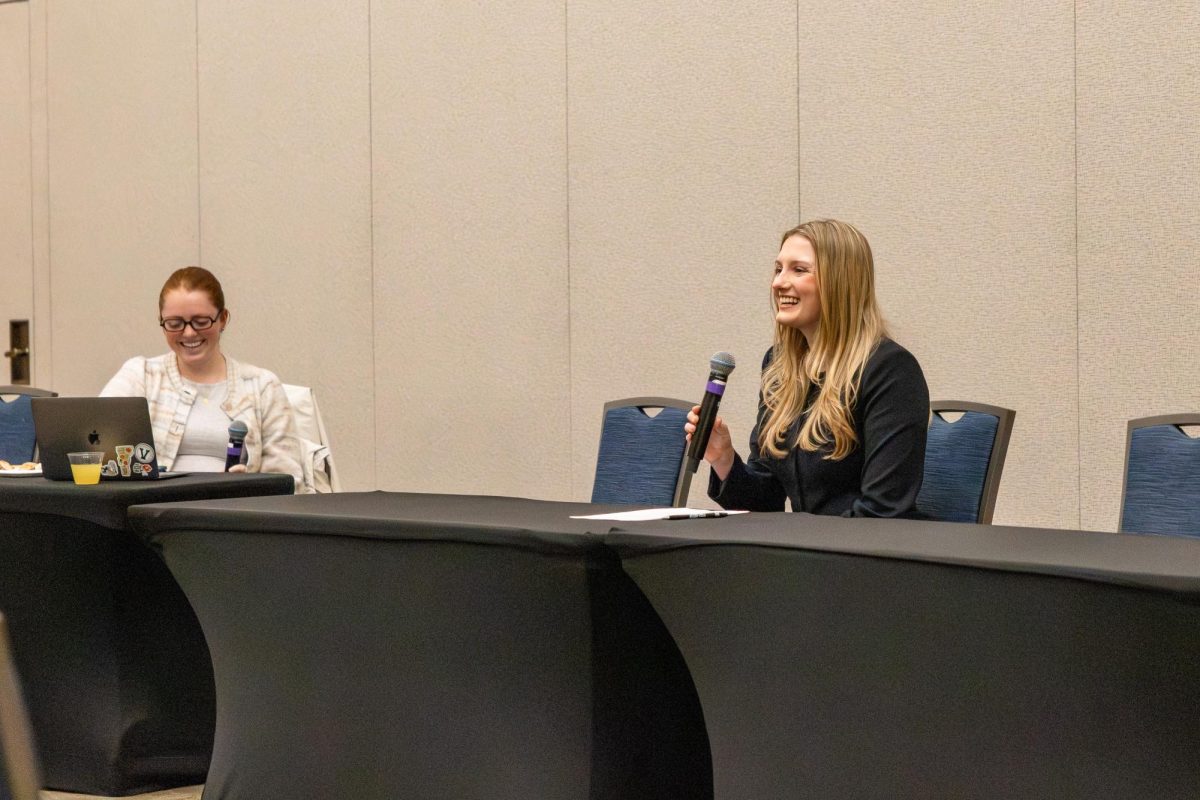
At noon in Old Mill’s John Dewey Lounge, Dr. Myrle Ballard led a talk on the importance of Indigenous food sovereignty.
He explained how Indigenous people have worked to rebuild food systems damaged by colonialism, themes central to the 2020 documentary “Gather.”
Over 20 people attended the event in person. Attendees were asked to view the documentary prior to attending.
Ballard, who attended virtually, is the Canadian research chair of Indigenous science and sustainability science, and a professor at the University of Calgary’s department of Earth, Energy and Environment.
A native Anishinaabemowin speaker, Ballard is Anishinaabe from Lake St. Martin First Nation. Understanding Indigenous language is essential to informing sustainability efforts, she said.
“In my language, ‘pimachiiwin’ means the ability to look after yourself, and ‘sustainability’ in Western concept is the ability to look after the future, development, means of industrialization, et cetera,” Ballard said. “These are concepts that mean the same thing, but they are totally different.”
In her research, Ballard has coined a “three-eyed seeing framework” to describe how Indigenous science, Western science and human relations with the natural world can work in tandem.
Colonization has deliberately destroyed many Indigenous food systems and practices, Ballard said, citing the intentional mass slaughter of buffalo by European settlers, a species essential to the culture of Indigenous nations.
“Gather” spotlights the efforts of Indigenous peoples to reclaim ancestral food systems and practices.
This reclamation of food sovereignty allows native people to regain control over what they eat, how it’s grown, and how it’s shared, Ballard said. More than just food, these efforts promote connecting with ancestral knowledge, language and spiritual practices.
First-year Claire Speakes, a sustainability, ecology, and policy major, said she attended the talk to learn more about Indigenous knowledge systems and activism.
“I’ve always been interested in Indigenous relations to the land,” Speakes said.
While she found the event informative, Speakes said she hoped to see her fellow students learn more about Indigenous issues.
“I would’ve liked to see more UVM students in there,” Speakes said. “Maybe if people got more involved and understood this kind of stuff, it would help out with activism in general and understanding the connection between the land and Western science and Indigenous science.”
Medicine Bag making workshop with Chief Brenda Gagne
At 2:00 p.m. in the Davis Center, Chief Brenda Gagne of Vermont’s Abenaki Nation of Missisquoi guided attendees in making traditional medicine bags, distributing sacred medicinal herbs.
Medicine bags are intended to hold both medicine and other items significant to the wearer, said Shoulderblade. These sacred medicines distributed at the event included tobacco, sage, cedar and sweetgrass.
This event’s purpose was to share a cultural tradition with the broader UVM community and share the importance of traditional medicine and its uses to Indigenous people, said Shoulderblade.
Attendees were asked to abstain from alcohol and drugs for at least four days prior to the event in order to respect cultural norms for handling the medicines, according to an Instagram post from the First Nations’ Collective.
Food sovereignty and Indigenous cooking with Chef Brian Yazzie
The Livak Ballroom hosted an audience of 30 to 40 people as Chef Brian Yazzie presented an autobiographical account of his connection with food and cooking throughout his life.
The presentation opened with land acknowledgements led by Issac Shoulderblade and a dance performed by HoonMana Yazzie-Polk, another member of the Diné tribe and Yazzie’s wife.
HoonMana expressed the importance of remembering the suffering that Indigenous people have endured. Because histories of oppression and forced assimilation still impact Indigenous people on a daily basis, HoonMana finds it important to display her culture and demand the space to practice her traditions.
Accompanied by a recording and video of the men’s version of the dance, HoonMana performed the women’s dance in the open area in front of the room, shuffling up and down the aisle in tandem with drum beats and shakers.
The dance served to appreciate and remember the suffering of their ancestors as well as to give thanks to the land they were on and the ingredients that would be used for the meal. Staying connected to the ingredients is a key part of staying connected to the traditions and food, Yazzie said.
After the song, Yazzie took the floor and recounted how food and cooking have played a large part in shaping his life.
“I started cooking at around the age of seven. [In a] single-parent household, seeing [my mother] work so hard. So I ended up helping her in the kitchen. That’s just kind of how I found my space in the kitchen,” Yazzie said.
Cooking eventually led him to be the first in his family to go to college.
Yazzie graduated from St. Paul’s College in Minnesota for culinary arts. He then chose a career in restaurants, exploring his passion for reintroducing Indigenous flavors into contemporary dishes while maintaining affordable rates and giving back to his community, he said.
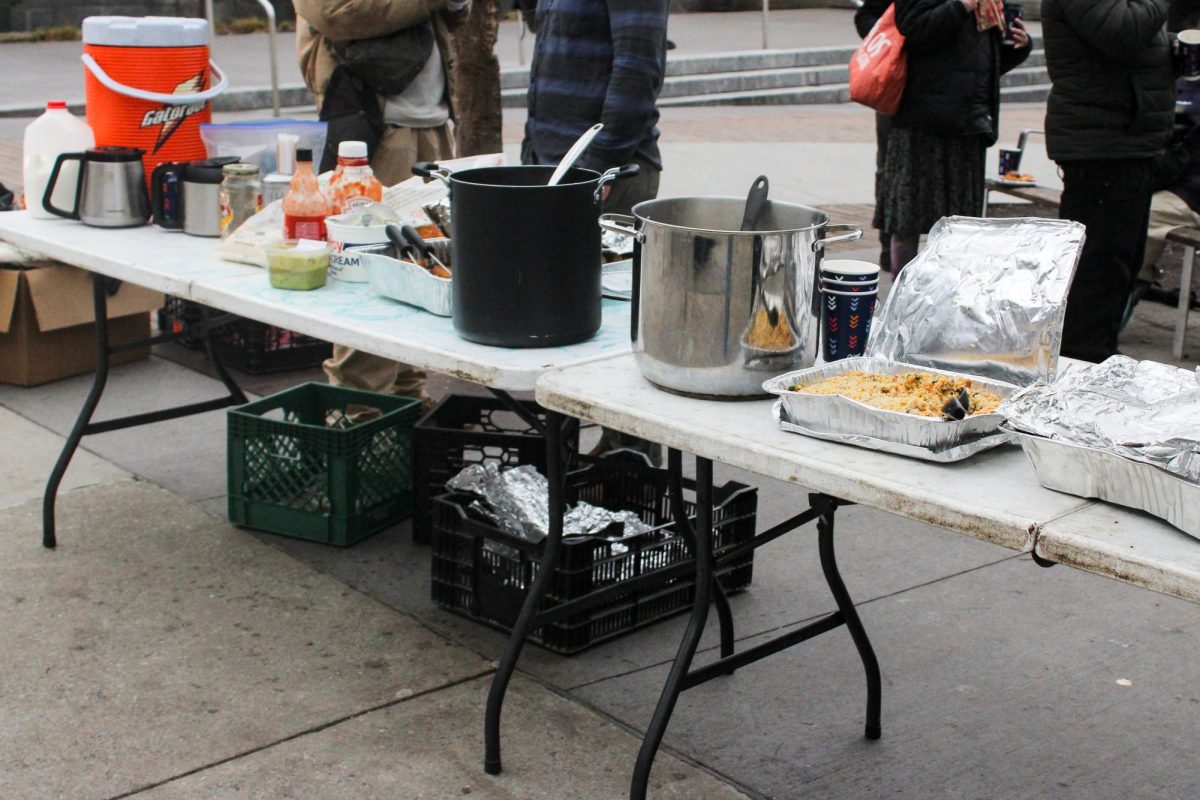
As the presentation drew to a close, Chef Yazzie began a cooking demo on a small portable stove while answering questions from the crowd.
Attendees lined up for lamb, bison meatballs, roasted root vegetables and corn mush. Chef Yazzie carefully chose these ingredients for their importance to his Diné culture, he said.
“I always choose corn for the fall flavor … but also for Navajo, it’s our first and last meal, Yazzie said. “When you’re a baby, you’re going from a liquid diet to a solid diet, right? And when you’re getting old, you’re going back from a solid to liquid diet again … it’s like a full circle.”
Bison were integral to many indigenous peoples, particularly the Lakota, Nakota, Dakota and other Sioux tribes who relied heavily on them for food and resources. Their growing availability on farms is part of their population’s slow recovery and return to the plains after the mass killings inflicted by European colonizers, HoonMana said.
“I will always cry every time I hear that ‘cause you don’t see that anymore; It’s so amazing to be able to feel them come back,” HoonMana said about the bison populations returning to the plains.
Chef Yazzie says that the most meaningful part of his work is being able to expose more people to Indigenous foods, affirming the continued existence of Native peoples.
Yazzie mentioned that this was many people’s first time trying bison.
“Their eyes are getting big, like, ‘what is that?’ They haven’t tried that. I just had two people say that they haven’t tried, and then they just pick it up. So for me, it’s that connection, it’s that reconnection,” he said.
MoonHana also hoped to foster a connection between her non-indigenous and indigenous people through the day’s events. She also hoped to spread awareness of the continued struggles of Indigenous people.
“I want people to find the connection between their own lives and how they live, and think about how they would have to change their lives if they were Indigenous,” she said.