
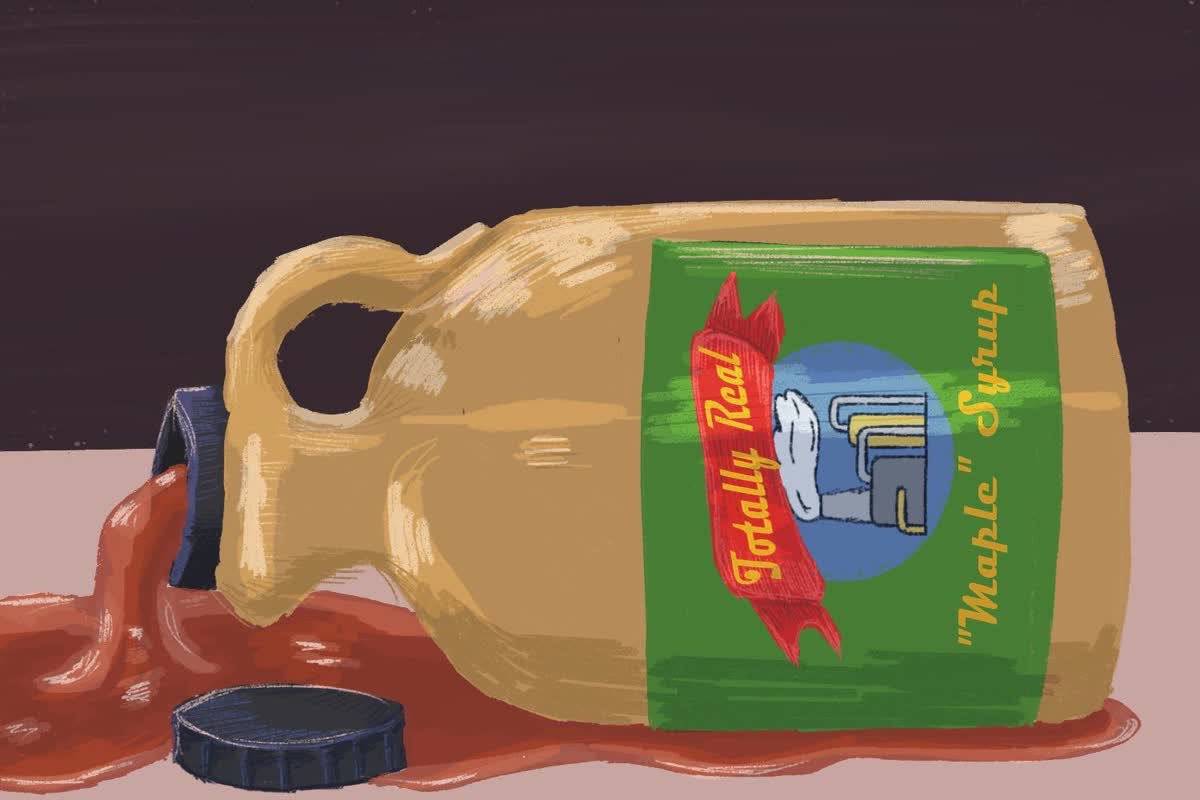
With sugaring season in full swing, we may again ask the age-old question of which is better: real or fake maple syrup.
Real maple syrup is produced from millions of taps from trees across Vermont, while the fake version is made in factories from corn syrup.
As a Vermonter, I feel utterly insulted when someone suggests that I buy a bottle of artificial corn syrup over my favorite tree sap.
There is, after all, simply no replacement for real maple syrup.
But my opinion goes further than this simple claim of preference. I would argue that anything that is not real maple syrup should be avoided altogether.
Fake maple syrup is the most despicable of imitations: a crude concoction of high fructose corn syrup, dyes, cellulose gum, preservatives and artificial flavorings.
It is not only disgusting but dangerous as well, as consistent consumption of high-fructose corn syrup can lead to a myriad of health issues. These include but are not limited to: heart disease, type 2 diabetes and chronic inflammation, according to the Cleveland Clinic.
When compared to the effects of maple syrup, we see that the consumer’s health is largely benefited by maple syrup.
Besides having a considerable amount of vitamins and minerals, maple syrup offers many antioxidant and anti-inflammatory compounds, according to a 2023 Heliyon review of maple syrup.
Maple syrup may even help protect against type 2 diabetes, according to a 2013 J-Stage paper.
Fake syrup is even worse once its environmental impacts are considered.
These impacts are derived from the use of pesticides and fertilizers in agricultural production. Corn, which is used in corn syrup, produces 40% of nitrous oxide emissions in the U.S., according to a 2025 EWG analysis.
This does not even take into account the effects that tilling has on the soil, the water demands of agricultural fields or the impact of harvesting and processing that these goods have on the environment.
Maple syrup, on the other hand, is a largely sustainable product. The only pollution in the process comes from the fuel needed to boil off the sap’s water content.
The benefits of real maple syrup extend beyond this when we also consider the elegance and artfulness of its production — a process which no factory could imitate.
Last fall, I walked through the Bourdon Maple Farm in Woodstock, Vermont. Its infrastructure was intimately intertwined with the landscape. Sap lines ran from tree to tree along the narrow trails winding atop the hill.
The Bourdon Farm is just one of more than 1,000 members of the Vermont Maple Syrup Makers Association.
The thousands of independent, family-owned sugarhouses across the state provide us with our maple syrup, ensuring the product’s status as a craft rather than a simple commodity.
These are our community members, neighbors and friends.
One may support and contribute to their local sugarhouse on occasion, but remain largely attached to fake maple syrup the rest of the time. But this is not support; rather, it resembles a penance paid for killing an industry.
With drawbacks so severe, I question why anyone would ever prefer the fake stuff.
But I understand that fake maple syrup as a product cannot be debated without mentioning what is perhaps its only redeeming quality: it is significantly cheaper than maple syrup.
A gallon of Pearl Milling Company “syrup” can be bought for about $25, while a gallon of Vermont-branded maple syrup can cost as much as $65.
This may be the reason why such a large culture has grown around fake maple syrup.
However, cost-saving measures as a reason for preference are not good enough to justify its use. Cost saving at the expense of one’s health, the health of the environment and the health of the community is not cost saving — it is cost preference.
There is no part of me that believes passing regulations banning fake maple syrup is remotely realistic, as the U.S. government does not have an extensive history of regulating foodstuffs in this manner.
But I believe self-regulation is possible.
The influence that each person can exert with their patterns of consumption is immense. And while we cannot depend on fake maple syrup being removed from grocery store shelves, we can depend on our individual impact.
This impact may only be exacted through the direct support of local maple farmers and the industry as a whole.
So, this sugaring season, skip the fake stuff and buy real maple syrup. Better yet, visit your local sugarhouse and buy it there. Your life will be sweeter.