

A previous version of this article stated that eight U.S. municipalities had adopted the pledge; however, there have only been six in the country, the other two being Canadian municipalities. The article now includes the correct number as of Feb. 19, 2026, at 3 p.m.
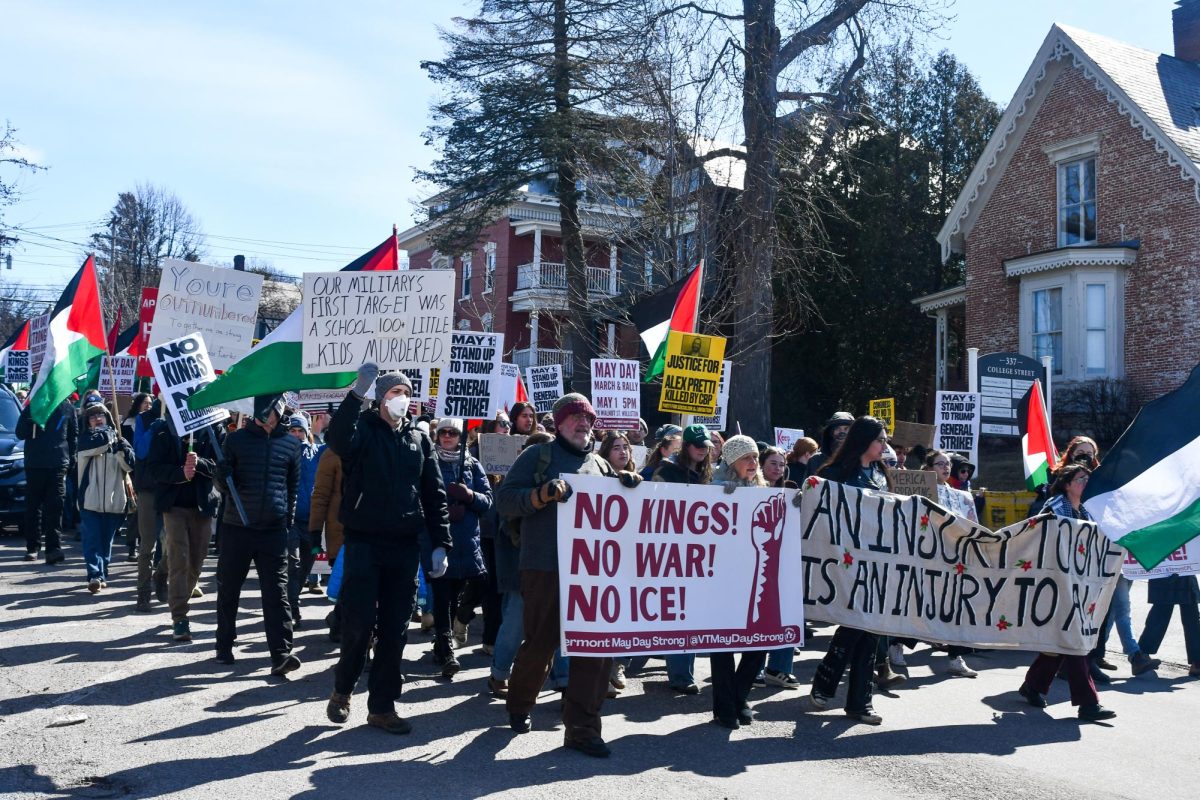
On Monday, Jan. 26, the Burlington City Council rejected a citizen-led petition to place the Apartheid-Free Communities Pledge on the March ballot.
This was the correct decision.
The Apartheid-Free Communities Pledge is a statement that pledges to end support to “Israel’s apartheid regime, settler colonialism and military occupation.”
The Burlington City Council’s vote last month was the third time it has rejected placing the pledge on the ballot since 2024.
The pledge is non-binding, and six U.S. municipalities have approved it. However, city councilors and opponents of the pledge have argued it is one-sided and would further divide the Burlington community, according to a Jan. 2024 VTDigger article.
Whether or not Israel is practicing apartheid against Palestinians and Israeli Arabs has been the subject of much debate. Apartheid is a policy of racial segregation, according to Merriam-Webster.
The Israeli government and policies have discriminated against Israeli Arabs and Palestinians as well as restricted the movement of Palestinians, according to a Sep. 2025 BBC article.
Israeli Arabs are largely segregated from Jewish Israelis. However, there are also communities where Jewish Israelis and Arab Israelis live together, and both serve together in the government, according to a Sep. 2021 BBC article.
Supporters of the pledge have argued that Israel practices apartheid and that Burlington is complicit because of U.S. tax dollars that support Israel.
However, if approved by Burlington voters, the pledge would have declared Burlington “apartheid-free” without eliminating Burlington’s federal tax dollars that fund Israel.
The Apartheid-Free Communities Pledge also references Israeli settler colonialism.
Israeli settlements in the West Bank are horrific. However, the term settler colonialism has often referred to the state of Israel itself and not Israeli policies.
“People from a colonizing nation or state migrate to an area and establish a settler colony that functions to extend and maintain the colonizing power’s control over the area,” is the definition of settler colonialism from Merriam-Webster Dictionary.
Jewish people have lived in present-day Israel for over 3,000 years. After the Roman Empire conquered Jerusalem in 70 C.E., many Jewish people fled to Europe, according to the Florida Center for Instructional Technology.
As a result of European pogroms and the Holocaust, more than 400,000 Jewish people immigrated to present-day Israel from Europe. This led to the creation of the state of Israel in 1948, according to the Holocaust Encyclopedia.
Both the Palestinian and Jewish peoples are indigenous to Israel-Palestine. However, in using the term “settler colonialism,” the Apartheid-Free Communities Pledge delegitimizes Jewish people as indigenous to the land of Israel.
The wording falsely implies that Jewish people were immigrating to increase the political control of a colonizing state and not fleeing from persecution.
By describing Israel as a settler colonial state, the pledge also implies that Jewish people don’t have the right to self-determination — the right of a people to form a country.
At the Jan. 26 City Council meeting, supporters of the pledge argued that refusing to place the resolution on the ballot is undemocratic, according to a Jan. 27 Seven Days article.
Non-binding resolutions must receive the signatures of 5% of registered Burlington voters in order to be placed on the ballot. The Apartheid-Free Communities Pledge surpassed that number, according to a Dec. 2024 Seven Days article.
However, the Burlington City Council has the authority to reject non-binding resolutions from appearing on the city ballot, according to a Dec. 2024 WAMC Northeast Public Radio segment.
In 2023, an effort to amend the process and remove the city council’s authority was rejected by Burlington voters, according to a March 2023 VTDigger article.
The Jan. 26 vote to reject the Apartheid-Free Communities Pledge from appearing on the ballot isn’t undemocratic. It’s the direct result of democracy.
This is because the majority of Burlington voters approve of the City Council’s ability to reject non-binding resolutions from appearing on the ballot.
At the meeting, a point of contention was whether or not the pledge is a local issue. Supporters of the pledge argued that because the U.S. sends foreign aid to Israel, it’s a local issue for Burlington taxpayers.
However, the pledge fails to petition the U.S. government to modify American policies regarding foreign aid and doesn’t directly reference taxpayers.
The pledge also fails to explicitly condemn antisemitism and Islamophobia in the U.S.
Since Hamas’s attack on Israel on October 7, 2023, incidents of antisemitism and Islamophobia in the U.S. have grown at a rapid pace, according to an Oct. 2024 BBC article.
If the Apartheid-Free Communities Pledge had been placed on the city ballot, it wouldn’t have changed the conflicts in Israel or the Palestinian territories. It would only have further divided Burlington.
The city council made the right choice.