

Founded in April, UVM’s first women’s flag football team has discovered an untapped curiosity about the sport. Now with 50 players, most of the club has never played flag football before.
Women’s club flag football planned to select players from tryouts in October because of funding and equipment constraints. But cutting some students off from flag football just didn’t feel right, junior club president Katie Williams said.
Instead, they would take everyone.
During February’s Super Bowl, an NFL Flag 50 commercial cued Williams into the women’s flag football boom. The campaign urged the installation of flag in high schools across the 50 states.
When she realized no team existed at UVM, she started one the following month.
Williams put out a call for board members on Snapchat, bringing eight women together to found and run the team. When the club convened for its first time in April, 30 prospective players turned out.
At the September ActivitiesFest, the club ran out of paper for sign-ups, and by its first how-to-play meeting, the numbers had nearly doubled from the spring.
“We had so much interest at the first meeting where we didn’t even have enough chairs to fit the amount of people that we had,” junior board member Meredith Reynolds said. “We were like, ‘Will this last?’”
Fifty students have joined the team’s 10 practices since, starting from the basics.
Only 2 in 10 of the club’s members have played flag football before, Williams said, requiring more coaching than a typical college-level team. The board selected first-year Alanna Espiritu — the only board member who has played in the past — to be student coach.
“I had to change my mindset and teach people how you think of it from someone who’s never played before,” Espiritu said. “Like, ‘this is how you catch not knowing how to catch at all.’”
Espiritu started playing on a co-ed flag football team of mostly boys at eight years old.
She was fortunate to have an all-girls high school team in her Virginia hometown — a recognized varsity sport in only 14 states — and played through graduation.
As the student coach, she leads the team’s practices, in part by teaching the rest of the board the drills they’ll be running each day. Having a first-year in leadership eliminates any uninviting power dynamics between upper and lower-classmen, Williams said.
“We’ve actually seen so much progress,” Reynolds said. “We were throwing footballs and they weren’t even close to spiraling, and I know that that seems like such a small jump, but you see people throwing spirals.”
Players moved on to running routes, pulling flags and finding their positions before their first intra-team scrimmage in early October.
“We put it into practice and we’re all like, ‘Oh my god, we can actually play a sport together now that none of us knew how to play before,'” Reynolds said.
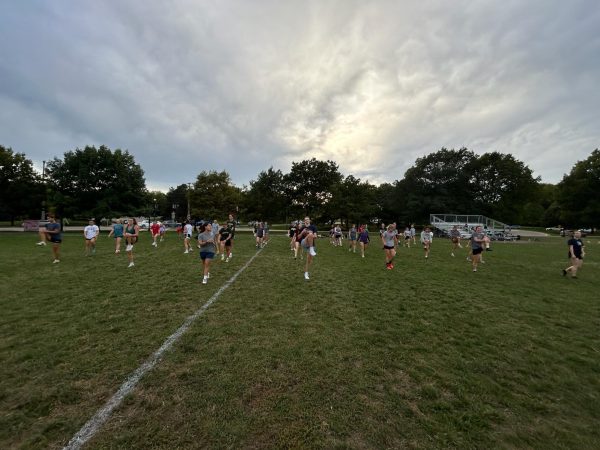
The club’s tryouts were used to sort players onto two teams based on skill level — 27 on the A side and 23 on the B side.
This fall, SGA allotted flag football $350, the typical budget for new clubs, which covered 20 flag belts and 10 footballs. Though welcome, the unexpected interest and scarce equipment have meant not everyone can play at the same time.
With its first active semester nearly done, Williams plans to apply for more funding from SGA in 2026. The money would go to equipment for all of the team’s players and, someday, a paid coach, she said.
Sophomore Eisha Qureshi has been to every one of the club’s events since last spring. Raised in a traditional household, Qureshi was told sports were unfeminine out of protectiveness by her parents.
“I don’t think there’s anything about sports that says that I can’t do it,” she said.
By the time of the club’s first practice, she had never played an organized sport or thrown a football before.
“I don’t feel like I’m out of place because everyone’s learning,” Qureshi said. “‘I can play flag football,’ is such an empowering thing to say.”
In February, the NCAA made an official recommendation that its three divisions consider the induction of women’s flag football into the Emerging Sports for Women program.
If voted in, women’s flag football will be in the running to become the NCAA’s newest varsity sport. Then, at least 40 schools would need to have sponsored teams before flag is officially adopted.
By finding one another on social media and forming group chats, women’s flag football clubs from Northeast schools have taken it upon themselves to function as fully fledged teams.
Williams hopes to schedule games with SUNY Cortland and the University of Connecticut, for example, in a makeshift spring season as clubs become permanent fixtures at nearby schools.
In the meantime, weekly practices and scrimmage hours are top of mind, said junior board member Emma Morland. While their first games are in the works, having space for women’s flag football at UVM is a step in the right direction.
“There’s so many people who will ask Katie [Williams], ‘Hey can I borrow a football to practice with my friends between now and the next practice?’” junior board member Rowan Howrigan said. “There’ll be five to 10 people staying after to practice with their friends. It’ll be almost completely dark out, and they don’t want to go home.”