

The Francis Colburn Gallery in Williams Hall was adorned with 39 stories of the past on Oct. 9 — from schizophrenia patients on Coney Island to gay rights protestors in San Francisco.
Each scene was locked in a black frame befitting the title of Dona Ann McAdams’ “Black Box,” a book memoir of her life blending artistry and activism as a photographer.
The book for purchase has 107 photographs in all, each accompanied by a standalone written vignette.
Attendees sifted through the memoirs’ pages and roamed from picture to picture — engrossing themselves in McAdams’ career spanning more than five decades.
“The pictures are part of my life,” McAdams said. “They’re part of the causes that were significant to me, and I wanted to take stock in the work that I had made that didn’t have to be part of an assignment but just pictures that I liked. It was very gratifying.”
The “Black Box” refers to a camera obscura, the dark room where photo film is developed. McAdams has been developing analog photos her entire career, even with the onset of digital processing.
She produces her photos using the same silver gel and wet-pressing technique, and said that handcrafted productions have always been one of her biggest inspirations.
“My work is tremendously influenced by illustration, by picture books, by cartoons, specifically Ernie Bushmiller’s ‘Nancy,’” she said.
McAdams echoed that influence in her gallery, encasing each photo in the same black frame.
“The frame has always been really important to me, and I realized it’s the black border of an illustration that I’m working with. That’s what it is: it’s the little box we draw around the information,” McAdams said.
Each photo was taken on the Leica M2, McAdams’ first camera back when she started professional photography in 1974. Her foray into activism began in San Francisco in the ‘70s through her friendship and campaign involvement with Harvey Milk, the first openly gay man to take public office in California.
Capturing the queer scene in San Francisco, McAdams began to build her career photographing the alternative underground, documenting social justice movements in the ‘70s and the performing arts scene in the ‘80s and ‘90s.
“She’s always found a way to document so much artistic but also activist culture,” said Pamela Fraser, one of the gallery’s organizers and program head for art and art history. “She’s always been interested in a sort of liberation.”
McAdams would cross paths with notable activists like poet Angela Davis and artist David Wojnarowicz photographing protests for civil rights, women’s independence and AIDS awareness.
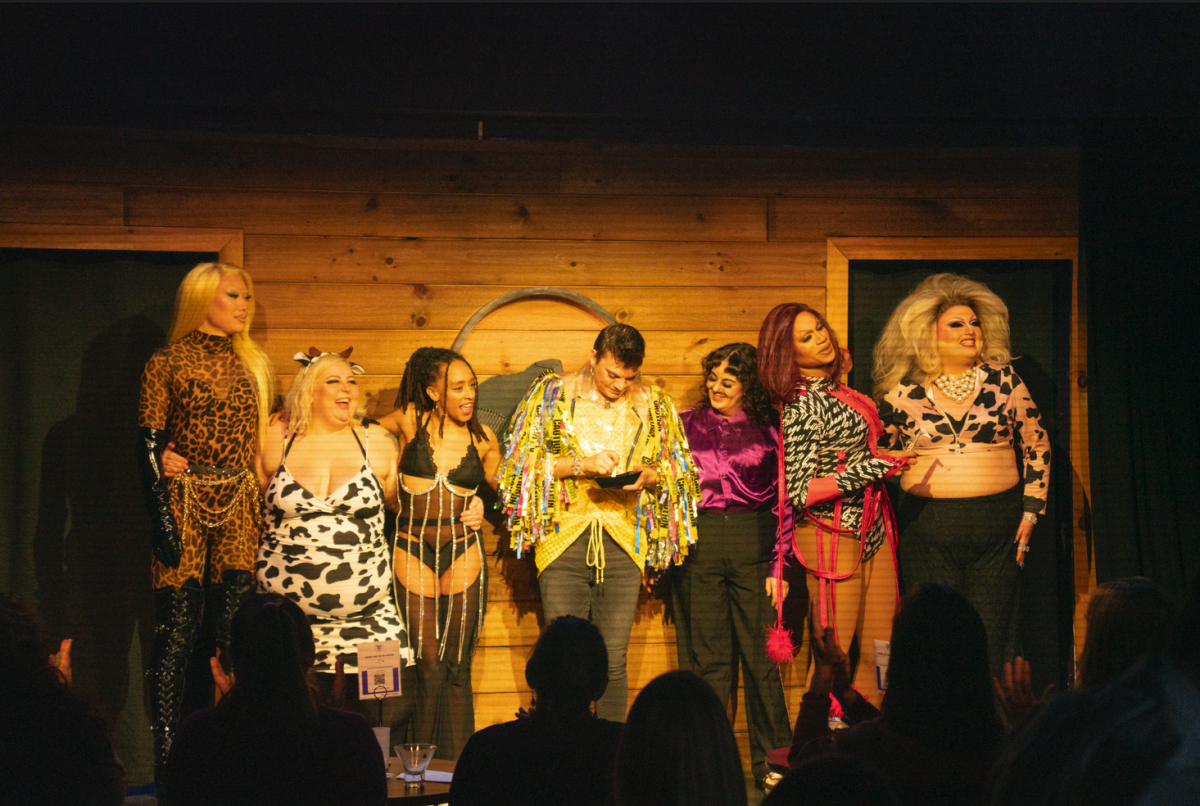
A little over a decade later, she found herself in New York’s East Village as a photographer for Performance Space 122 — cataloguing the productions of groups like the Lesbian Avengers and Split Britches as they whirled across the stage advocating for feminist and gay rights.
“Photographs are tools for activism, but they’re also tools of memory and feeling and love and anger,” McAdams said. “If you see something, photograph it. But also be incredibly empathetic about who you’re photographing.”
Brad Kessler, a novelist and McAdams’ husband, explained that empathy is the crux of her work. The two met working on a project detailing the lives of patients struggling with mental illness.
“Those photographs of the people living with schizophrenia was the first time it felt like the photographer and their subject were the same,” Kessler said. “When you look at her work, you see something that you’ve probably never seen in photographs.”
McAdams’ work has won numerous awards, including the Governor’s Award for Excellence in the Arts — the highest honor presented to an artist by the state of Vermont.
Despite those accolades and settling on a goat farm in Sandgate, vt., McAdams still carries her camera everywhere she goes.
“To be active, to be present in the moment, is to be alive,” she said. “Because you never know what’s going to happen.”