
U.S. Supreme Court Justice Sonia Sotomayor visited UVM earlier this week, delivering a series of talks centered on empathy, integrity and accountability in the pursuit of justice.
Her visit marked the first time a sitting Supreme Court justice has spoken at the University in over two decades, drawing large audiences as a rare opportunity to engage directly with a justice on the nation’s highest court.
Appointed to the U.S. Supreme Court in 2009 by President Barack Obama, Sotomayor served as the first Latina and the third woman ever confirmed to the Court.
Now one of only three liberal justices on a 6-3 conservative majority bench, the most conservative Court in modern American history, Sotomayor is known for her impassioned dissents and for being a leading voice of the Court’s minority bloc.
Sotomayor spent the morning of Oct. 20 reading her new children’s book, “Just Shine! How to Be a Better You,” to elementary students across Burlington, Winooski and Charlotte.
Later that day, Sotomayor met with UVM’s Presidential Leadership Fellows and a joint student class of law and political science students to discuss upholding constitutional principles in an era of division.
She concluded her visit with an evening discussion with UVM President Marlene Tromp, reflecting on justice and the power of civic engagement.
Law & Politics Classroom Conversation
At 3:00 p.m., Justice Sotomayor met with several of UVM’s Patrick Leahy Honors College and political science students in the Silver Pavilion of the Alumni House.
Sotomayor was welcomed by E. Thomas Sullivan, UVM president emeritus and professor of political science. The discussion was aimed at prospective legal scholars to discuss America’s most pressing constitutional issues, he said.
“How do we protect rights?” Sullivan said. “How do we preserve liberty? How do we ensure our government remains accountable to the people?”
Within minutes of the discussion, Sotomayor left her position at the podium and weaved through rows of students, resting her hands on chairs and shoulders, meeting the gaze of many along the way.
“Do you mind if I walk around?” she said. “Because they put all the VIPs up here, and I like [the students] better.”
The Q&A-formatted event was facilitated by Lisa Holmes, UVM professor of political science. Students had the opportunity to submit questions for Sotomayor in advance, and for each question selected, Sotomayor found the student in the audience to take a photograph together.
Born and raised in the Bronx, New York, Sotomayor graduated from Princeton University and Yale Law School, then served in both the U.S. District Court and the Second Circuit Court of Appeals, Sullivan said.
Sotomayor began by reflecting on her early years as a lawyer, urging students to seek meaning in every stage of their careers, even the frustrating or mundane.
“Every experience you have, look for it to teach you something,” Sotomayor said. “Even if you’re dying of boredom.”
Sotomayor’s understanding of justice evolved when she stopped viewing the law as fixed, but instead as dynamic and ever-changing, she said.
“Law is a regulation of people’s relationships with one another,” Sotomayor said. “Good laws are made by good people. Bad laws are made by good people who may be misguided.”
She emphasized that disagreements in judicial outcomes often stem not just from different ideology, but from different interpretation and a lack of context.
“I look at context much more broadly than some of my colleagues do,” Sotomayor said. “The Courts don’t have the power of the purse. The Courts don’t have the power of the army. All they have is the power of reason.”
As the conversation shifted toward the current state of the Supreme Court, Sotomayor acknowledged that students may feel uncertain about its future.
“If they start broadcasting executions, I have no idea what my Court is going to do,” Sotomayor said.
Still, Sotomayor’s focus shifted to determination, telling students that conviction matters most in times of division.
“You can’t give up because others are saying it’s impossible,” she said.“I’m a Don Quixote. I keep fighting even when I’m in a losing battle.”
The final student-submitted question asked, “In today’s world, what do you turn to to find hope?”
“You, the young people,” Sotomayor said. “My only hope is that you won’t be disillusioned, that you will take your energy and optimism to fuel a better future.”

An evening conversation with Justice Sotomayor
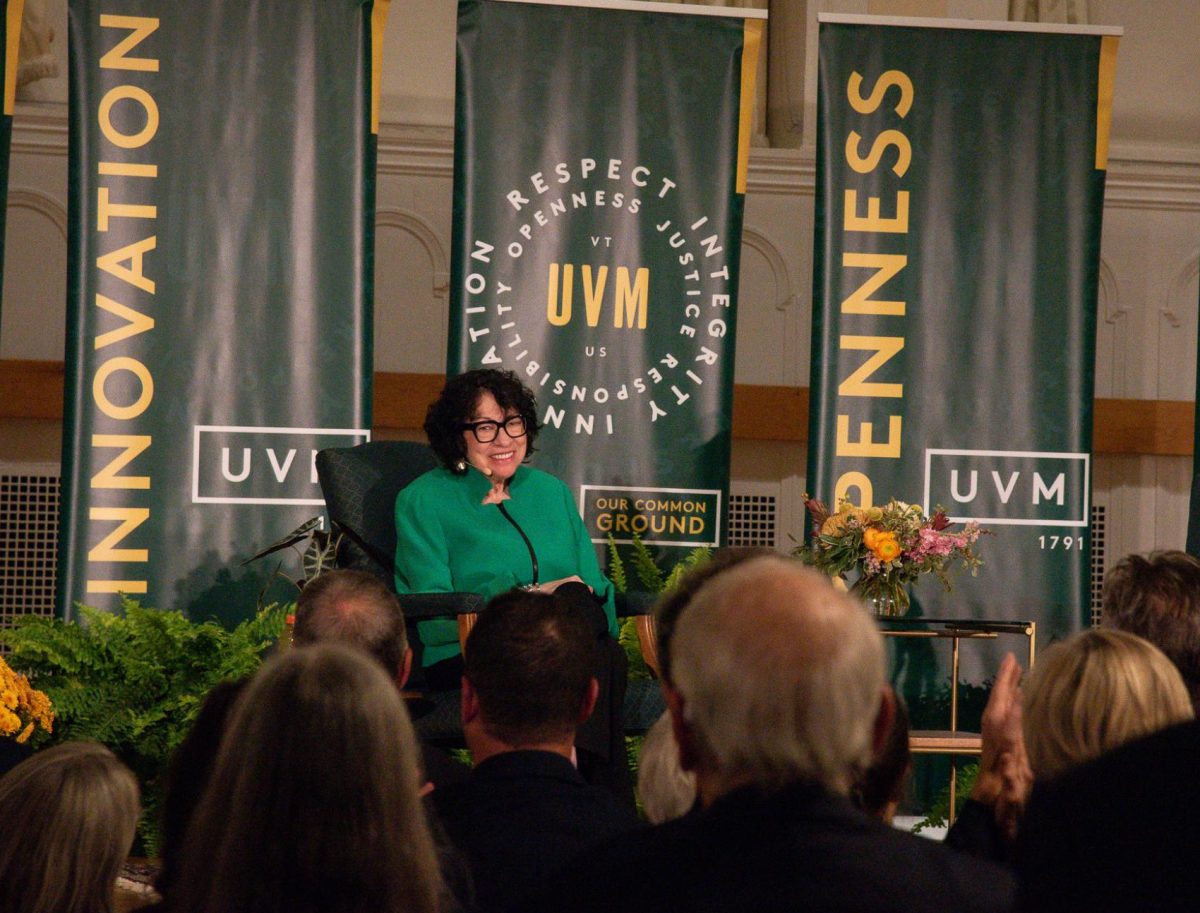
Despite the pouring rain, hundreds filled the auditorium of the Ira Allen Chapel on Monday evening to hear Justice Sotomayor in conversation with UVM President Marlene Tromp.
“Earlier today, [Justice Sotomayor] said you’d all stay away because of the rain,” Tromp said, referring to the crowd. “I said, ‘I’m not too worried.’”
The conversation is part of the second annual Leahy Public Policy Forum. Tickets to the event went out to the UVM community earlier this month and sold out within minutes, said Adam White, executive director of university communications.
While Sen. Patrick Leahy, D-Vt., served as chair of the U.S. Senate Committee on the Judiciary, he issued a statement in support of Sotomayor’s appointment. Leahy requested that Sotomayor speak at UVM, said David Jeneman, dean of the Patrick Leahy Honors College, who coordinated the event.
Sotomayor was welcomed with remarks from Gov. Phil Scott and Sen. Peter Welch, D-Vt., and a video message from Senator Leahy. The event followed a Q&A format, with Tromp guiding the conversation through a series of questions.
Senator Welch reflected on the significance of the conversation between Sotomayor and Tromp, that remarkable women from different backgrounds, the Bronx and Wyoming, respectively, could share the stage together that evening.
Sotomayor began the conversation by reflecting on her childhood growing up in the Bronx, and the mentors who shaped her past, sharing advice from her mother.
“I’ve never been afraid to ask a question and I’ve never been afraid to say ‘I don’t know,’” Sotomayor said. ““Sometimes you just have to jump — be a little stupid.”
Sotomayor’s understanding of legal argument evolved over her career. Legal writing is not about reiterating rigid facts, but persuading through both logic and emotion, she said.
“All good persuasive writing is not just the ordinance,” she said. “It’s the power of how you convince people of the ideas you’re expressing.”
Sotomayor discussed the powerful role of dissent and understanding that disagreement is essential to a fair judicial process.
“I see [dissent] as an opportunity to engage in the discourse,” she said. “A dissenting voice made is not injustice, necessarily. It is a different view of what the answer should be.”
Sotomayor also spoke about the nation’s immigrant roots. America has long depended on the contributions of immigrants and their children, she said.
“If [we] lose the understanding that America was built on the back of immigrants … then we’ll stop being great,” Sotomayor said.
Throughout the evening, Sotomayor emphasized persistence, urging students to face and embrace failure as a part of growth.
“Failure is very painful, but despite all of that, it is something you can withstand,” she said. “You lose the war when you walk away.”
Sotomayor recognized that in a time of government uncertainty, many people feel anxious about the future, she said.
“Change does not happen overnight,” Sotomayor said. “But what you shouldn’t do is walk away … That’s why I spend my time talking to young people. Because I truly believe that you have the energy, you have the drive, you have the hunger to do things different and better.”
As the conversation came to a close, Sotomayor returned to the theme of perseverance. She urged students to stay engaged — to keep fighting and believe in progress, even when the path feels uncertain.
“Put your heart into it,” Sotomayor said. “Every time you’re disappointed, cry a little bit … but once you’re finished with that, look up and say ‘let me get up and start again.’”