
Editor’s Note: This story was updated on April 22 at 2:41p.m. to correct the name of a course.
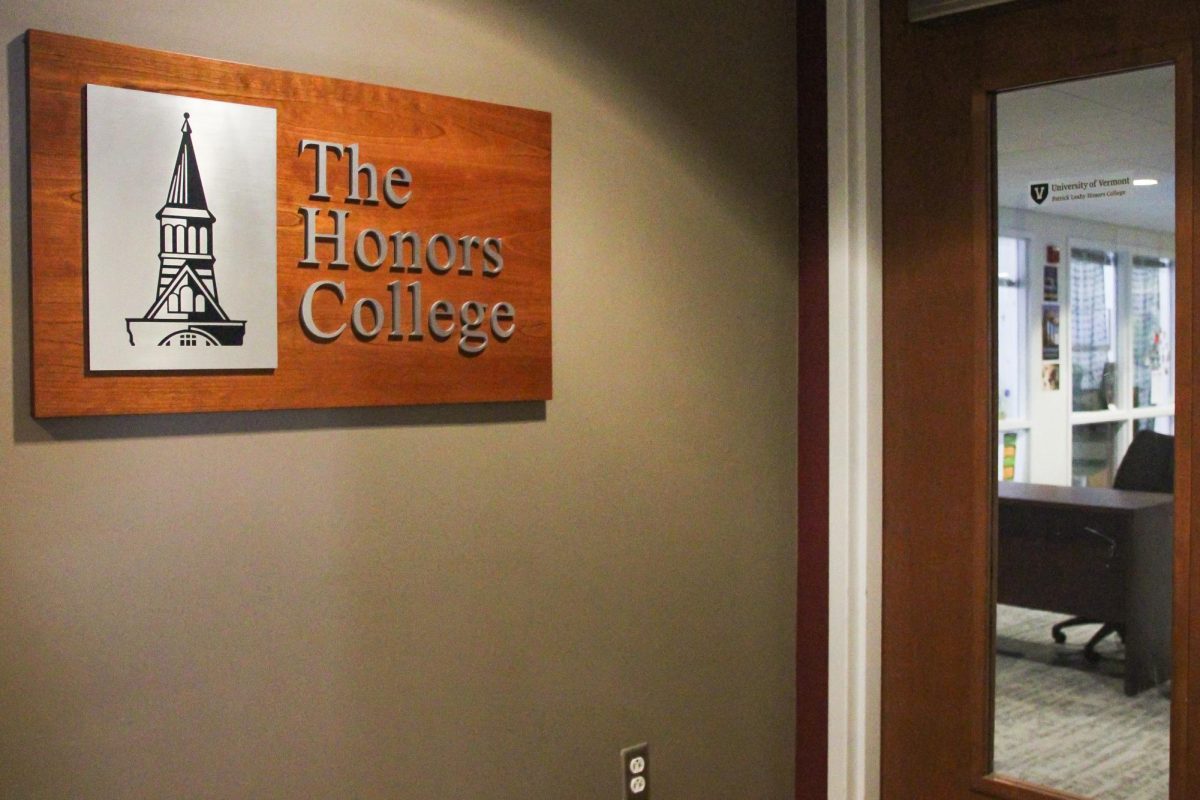
UVM’s Patrick Leahy Honors College provides unique opportunities not afforded to other UVM students, from guidance for students’ honors theses to pasta nights with the Dean.
However, which students gain access to these resources and the true meaning of the “Honors College” designation is often unclear.
“As a Patrick Leahy Honors College student, you’ll experience the benefits of a liberal arts college and the resources of a public research university,” the PLHC website states.
Lisa Schnell, Associate Dean of PLHC from 2008 to 2018, was involved with the PLHC for nearly two decades, both as Dean and as a professor.
“There was a lot of cross-pollination in terms of the sciences and the humanities,” Schnell said. “We really encouraged that, and had all kinds of ways of introducing students to the way that those boundaries are permeable.”
Current PLHC classes cover a wide variety of humanities subjects and skills, said sophomore Charlotte Reimanis, a PLHC student and former member of the Liberal Arts Scholars Program.
“You don’t have to be at a liberal arts college to have a liberal arts mindset,” Schnell said. “You have to be in a position where you can understand why all these different ways of knowing are valuable.”
PLHC was founded in 2004 with a single class called “The Pursuit of Knowledge.” The Honors College was created to help academically motivated students find community, Schnell said.
“When really terrific students came to UVM, they felt welcomed and they had friends, but they were also really seeking academic intellectual community,” Schnell said. “They were having a really hard time finding it and a lot of them left to go to smaller places.”
According to Reimanis, the creation of the PLHC was partially driven by the goal of bolstering UVM’s academic rankings.
“It seems like it was created to get better students to apply to UVM and kick up UVM’s caliber in a way,” Reimanis said. “Instead of coming from more of a grassroots goal of ‘let’s make a school where people really want that extra learning push.’”
Alongside other UVM professors, Schnell taught “The Pursuit of Knowledge” course to Honors College students from 2004 to 2008, when she became the Associate Dean of the PLHC.
“The Pursuit of Knowledge” curriculum centered on improving students’ critical thinking skills and sought to teach students skills transferable to any class and major, Schnell said.
“We read a bunch of philosophy, Descartes, Hume, Aristotle and others,” Schnell said. “And also read things from different disciplines and then took a metacognitive look at the way in which a problem was being approached by different disciplines.”
Since its creation in 2004, the PLHC has grown to approximately 1,000 student members in response to factors such as larger applicant pools, Schnell said.
“The class size at UVM has changed, and also the selectivity at UVM has changed,” Schnell said. “It’s a much more selective school now than it was in the early 2000s or 1990s, and that’s partly because of the Honors College.”
The PLHC’s available support for students increased UVM’s appeal to academically motivated students, influencing the university to expand the program and increase funding, Schnell said.
Another result of this growth is that there is no longer a common course for all PLHC students.
“The common syllabus went away,” Schnell said, “And I understand why it had to because of [growth of the PLHC].”
Currently, PLHC students choose one seminar class from several courses exclusively offered to Honors College Students, said sophomore PLHC student Tran Vu.
A Molecular Genetics major, Vu is taking a course called “Food, Power & Sustainability.” The course covers the sociology of food, including where it comes from and who provides it, Vu said.
“It’s such a different topic to talk about, and such a different way of thinking about food,” Vu said.
“For a lot of the HCOL classes, I talk about how abstract they are, but that’s the beauty of them,” Vu said. “In my freshman year, I was put into a class called The Ideological Warfare in Ukraine.”
According to Vu, HCOL classes such as “The Ideological Warfare in Ukraine” and “Food, Power & Sustainability” helped widen her academic perspective and grant her a break from the tedium of STEM classes.

Despite providing many academic resources, the PLHC does not make it clear what students should expect upon admittance and in PLHC classes, said first-year James Liephart, who was accepted into PLHC but opted to join LASP instead.
LASP is a learning community where students apply to take courses in a specific area of interest. There are six sub-programs focusing on art, the environment, humanities, life sciences, social sciences and world languages and cultures.
Liephart believed that joining LASP guaranteed acceptance into the PLHC and chose to pursue a humanities-oriented program in his freshman year, but was not accepted upon re-application.
Referring to the 2026-27 academic year, Liephart said that sophomore acceptance into PLHC may have been contingent on the program applicants were enrolled in.
“It was clear even in the message or in the rejection letter that a lot of people got, that the reasoning behind [the rejection] was very much dependent on our program,” Liephart said. “Seemingly, nobody from the arts got in.”
Sophomore PLHC applicants for the 2026-27 academic year received rejection letters through email.
“Decisions were also informed, in part, by which departments had capacity to supervise Honors College theses in addition to our current first-year cohort,” stated rejection letters for the 2026-27 academic year.
During the 2024-25 academic year, a 3.7 GPA for students in LASP granted them automatic acceptance into the PLHC as a sophomore. This policy was changed when approximately 75% of transfer admissions into the PLHC were from LASP, Reimanis said.
These misconceptions about the PLHC may be due to its website not effectively representing what the Honors College has to offer, Vu said.
“I was a bit nervous because I only visited the Honors College for my admitted students day,” Vu said. “I didn’t know anything else besides the fact that they make you take an extra seminar class as a part of HCOL curriculum.”
According to Vu, the lack of advertising for PLHC offerings has made the Honors College feel “otherworldly.” This, coupled with negative student accounts of heavy workloads, presents a polarizing view of the PLHC for incoming students.
One such PLHC requirement is that students must write a senior thesis on their area of focus in order to graduate.
This seemingly daunting task is made accessible by granting students flexibility in what they research and by offering a thesis preparation class during the PLHC students’ junior year, Reimanis said.
“If you have a good mentor in your department, it really shouldn’t be a problem,” Reimanis said. “I feel like that additional support is very useful.”
As a liberal arts-focused Honors College, the avenues students have to pursue research should extend into the humanities, Liephart said.
However, when Schnell stopped teaching PLHC classes two years ago, there was increasing STEM student enrollment in the Honors College. The increase may have been owed to external factors such as new STEM facilities at UVM, Schnell said.
For students accepted into PLHC, the Honors College offers a wide variety of resources and community events to benefit students, Vu said.
“It’s comforting, because you have a lot of people around you who have had similar experiences to you, so it feels a lot easier to just tell them about how your experience has been in comparison to maybe talking with other people outside of the Honors College,” Vu said.
Reimanis agrees.
“The contrast between smaller community and bigger scope of school ended up working out really well,” Reimanis said.
Reimanis said this community experience defines students in PLHC more than academics.
“I think it has less to do with perceived smartness and more to do with the community experience,” Reimanis said.
Vu said that being a part of PLHC has been an incredibly fulfilling experience, providing her guidance in research and allowing her to explore her interests.
“I’ve never regretted being in [PLHC] at all,” Vu said. “The HCOL student classes gave me a tool set where I could research properly, and it gives you a space where you can look into your own interests too.”