

Under the glass roof of UVM’s Main Campus Greenhouse, warmth and foliage flourish even in the cold winter months.
First established in the early 1990s, the building is home to over 400 plant species from around the world. The space allows students to get hands-on experience and provides research support to faculty across multiple departments, said Greenhouse Facilities Director Derek Allen.
“We are a core facility,” Allen said. “We support the needs of the College of Agriculture and Life Sciences, as well as the university more broadly.”
The plants grown in the building can be found across campus. Some plants are maintained to decorate event spaces, while others are sold to students at plant sales.
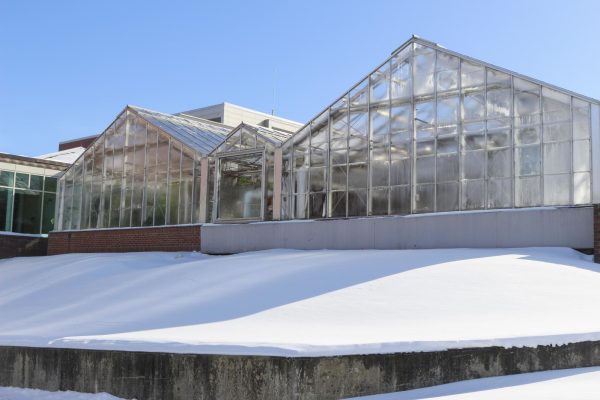
Several of the Greenhouse’s 11 rooms, or houses, are dedicated to classes, he said.
“There are a lot of opportunities to take a class that will put you in the greenhouse, from plant illustration to your bio lab to a horticulture class,” said senior Em Cantalupo, an intern at the greenhouse and a biological science major.
Currently, around 600 students in a biology core course, BCOR1450, are growing and treating their own corn plants in the greenhouse. The semester-long experiment allows students to pick and test their own hypotheses, said BCOR Lab Coordinator Erin O’Neill.
The project started with the students planting the corn, and will eventually culminate in them cutting and dyeing pieces to view under a microscope and analyze. She described it as being more representative of the real world of science.
“They’re really going to see the whole experiment all the way through, instead of just 2 hours and 45 minutes in the lab,” O’Neill said.
O’Neill did the experiment herself when she was an undergraduate at UVM, and now, years later, she organizes it.
“That’s really pretty special, yeah,” she said. “Full circle.”
When students aren’t available during weekends and breaks, the greenhouse staff maintain the corn, O’Neill said.
Just next door, Allen grows over 3,000 cauliflower plants a year to feed the insects studied by entomologist and UVM professor Yolanda Chen, he said.
“It’s just a never-ending production chain of cauliflower,” he said.
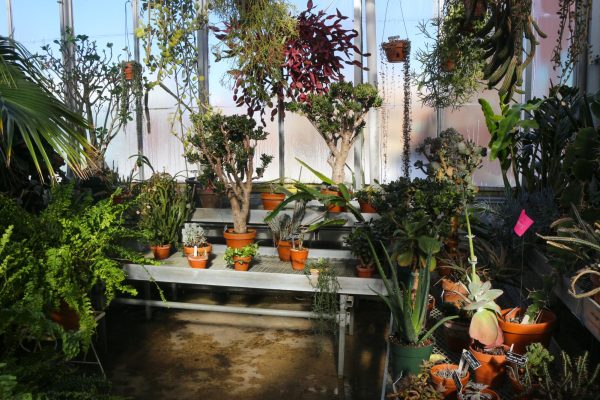
Individual houses can be set to their own temperature and environmental conditions. While most are warm, one house is cooling down to mimic winter.
Right now, the greenhouse is lowering temperatures for the 2300 trees. In her third year of her PhD, Nora Heaphy is studying red spruce with professor Stephen Keller, Heaphy said.
For the study, Heaphy and others collected seeds from hundreds of trees in the northern U.S. and Canada before germinating and planting them in the lab. They aim to gain a better understanding of the role of hybridization between black and red spruce in climate resiliency.
“Most of our red spruce trees up here have a little bit of black spruce ancestry in their genome,” Heaphy said.
Past research found that the trees with some black spruce ancestry thrived, she said.
“It may be part of red spruce as a species have managed to adapt to different climates across its range here in Vermont and then down in North Carolina,” Heaphy said. “It may play a role in red spruce’s ability to adapt to climate change.”
In May, the trees will be planted in UVM’s research forest in Wolcott, Vermont.
“We can track them for years and years,” Keller said. “[Nora’s PhD] will basically become a legacy for another student or students down the road that continue to study these trees over time.”
Students involved in work-study programs or internships at the greenhouse help maintain the houses alongside researchers and faculty.
“I get to water the plants, and I have a fertilizer experiment going right now,” Cantalupo said.
They said that the work is therapeutic.
“Everything is calculated,” Cantalupo said. “Like, you pick up a pot, and you have to figure out, well, how much water does this plant need? Will it last until tomorrow?”
Cantalupo did not have prior experience working in a greenhouse. The experience has been pivotal, they said.
“I realized I like working with my hands, I like the environment,” they said. “It’s definitely been the driver of the opportunities I’ve taken up.”
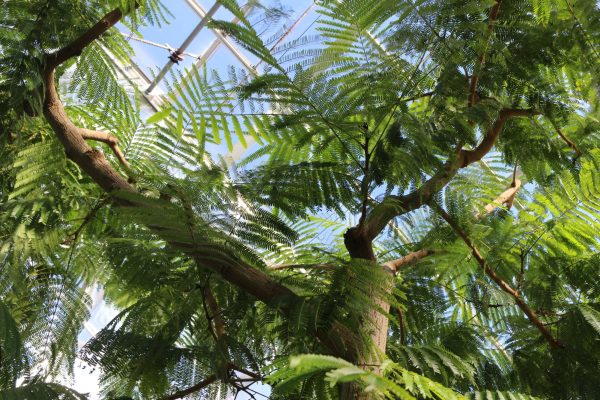
For junior Walt Regan-Loomis, interning in the greenhouse has provided them with practical knowledge that goes beyond outdoor plant growing.
“A lot of the things that we do that involve upkeep of the greenhouse are really similar to the things you would do with your own plants at home, just at a larger scale,” they said. “So having that practice is really nice to be able to then bring it back home and start implementing.”
They said starting the internship made them realize that they want to work in greenhouses in the future.
The space is not reserved exclusively for workers; two conservatories in the greenhouse are open to the public from 10 a.m. to 4 p.m. on weekdays. They feature a variety of plant species from other countries.
“You wouldn’t be able to see most of these plants unless you were actually traveling in very specific regions, mostly subtropical species, tropicals,” Allen said.
The greenhouse is one of the greenest spaces on campus during the winter, making it a popular spot for students to relax, he said.
“It’s cool that they have such an amazing variety of plants, even if you’re not doing a study in there, just walking through the conservatory is pretty special,” O’Neill said.
O’Neill encourages all students to visit the space.
“More people should come to the greenhouse. It’s so much fun,” Regan-Loomis said. “Even if you just want to sit and get some coffee with your friend and sit on the benches, it’s such a nice place.”