

Tucked away in Cohen Hall, behind a locked door and underneath protective white sheets, two blue metal machines have stood relatively unused by students since they were donated to the film and television studies department in 2023 and 2024.
For the first time this spring semester, the doors to these two Steenbeck 16 millimeter editing machines will open for students’ use as part of the curriculum for the FTS course Archival Filmmaking.
“It’s been a dream of mine to have these finally up and going,” said FTS professor Deborah Ellis, who created and teaches the course. “I’ve also noticed interest from students in analog equipment and understanding how this stuff works, so there has been some energy there.”
Steenbecks are flatbed editing machines that allow both sound and picture to be edited simultaneously, dating back to the late 1950s. They were the most common way filmmakers edited footage until digital editing took over in the 1990s, Ellis said.
The FTS department has two Steenbecks. One is a “six-plate,” meaning it can read one picture reel and two sound tracks. The other is an “eight-plate,” which can read two picture reels and two sound tracks.
The six-plate was donated to the FTS department by Peter Miller, the son of a friend of Ellis, who is an independent filmmaker now living in Europe. The eight-plate was donated by Peter Ciardelli, film program manager for the Hopkins Center for the Arts at Dartmouth College.
Students in the Archival Filmmaking class will have the opportunity to use both machines.
At the end of September, both machines at UVM were restored by Dwight Cody, founder and owner of analog film equipment business The Boston Connection.
The Boston Connection is the only restoration, repair and part-supply business for Steenbecks left in the U.S., servicing customers across the country and the world, according to Cody.
Cody has been working with Steenbecks since the 1970s. They are uniquely dependable and simple machines, compared to the complexly compounded technology of today, he said.
“In a way, Steenbecks are made of flour, salt and water; the really raw ingredients that are still feasible to come up with,” Cody said. “You restore a Steenbeck once, and you’re all set for another 25 years.”

A Steenbeck’s reliability also makes it very approachable to users in the educational sector.
“Steenbecks are incredibly user friendly, and you don’t get caught up with, ‘Where’s the button for this?’ like you do with technology on a computer,” Cody said. “So, many film schools really adapted to Steenbecks, and they still love them.”
In her journey of becoming a filmmaker, Ellis started editing with Steenbecks, and was obtaining her graduate degree in film when the industry’s switch to digital began.
Having a foundation in traditional film editing by hand showed her the value of the physicality the process entails, she said.
“There’s this sense of materiality that we don’t experience with digital editing that gives you a different appreciation to how we relate to our media,” Ellis said. “It can be tedious, but there’s something in that tedium that gives you a heightened sense of what you’re working with.”
UVM FTS alum Brendan Hollis ‘24 worked with Ellis using the eight-plate Steenbeck for a senior independent study. He still uses lessons learned from his time working with the Steenbeck today as a freelance filmmaker based in Chicago, he said.
“It really opened my eyes to how deliberate editing used to be, which has slowed down my process,” Hollis said. “Now, there’s a lot of pressure when you’re editing to do things quickly, but this machine made it seem like it was okay to take your time and give a lot of thought into your cuts.”
Hollis also took Archival Filmmaking in the spring of 2024, his last semester at UVM, when the class was offered for the first time. At that time, the Steenbecks were not available for use.
Nevertheless, simply being in the class itself showed Hollis why traditional film is important from a historical perspective.
“I love shooting, that’s why I got into studying film, but that archival class showed us a really important part of how film preserves history,” Hollis said. “It showed all the different layers that the archive has, and how you can create so many different kinds of art with those historical moments.”
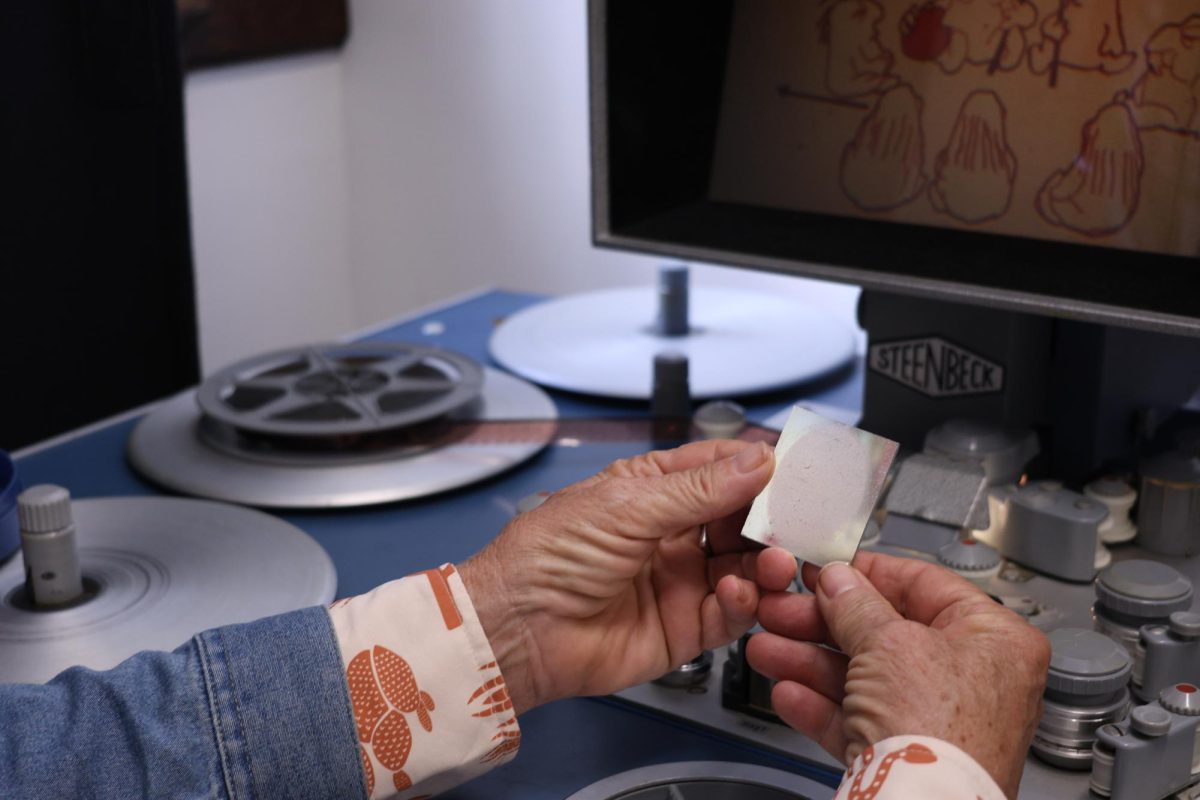
The Steenbeck enables filmmakers to explore the history that archival film holds.
During the summer, Vermont-based independent filmmaker Ben Silberfarb approached Ellis for help in reviewing old newsreel footage that he obtained from UVM’s Special Collections Library for an ongoing documentary project about a Burlington police scandal from the 1970s.
With Ellis’s help, the pair of them used the eight-plate Steenbeck to review hours of archival footage. Coincidentally, that exact machine was the Steenbeck that Silberfarb had used when he was an undergraduate student at Dartmouth College 35 years ago, Silberfarb said.
Silberfarb recognizes the crucial role that the Steenbeck played in his creative-investigative process.
“The only way to access this material is through these old machines, and luckily, Deb [Ellis] had them,” Silberfarb said. “They’re really hard to find nowadays, and it’s a resource that UVM students are really lucky to have.”
Ellis plans on keeping this resource available for UVM students in the future.
Next academic year, Ellis will teach another FTS class called “Cutting Up Lucy,” where students will be able to use the Steenbecks to review, edit and repurpose 16 millimeter film reels of episodes of the 1950s television show “I Love Lucy.”
“Students will take the lead in terms of how they use [the Steenbecks],” Ellis stated in an Oct. 28 email to the Cynic. “Right now we’re really in experimental, exploratory mode. But it’s so amazing to have our hands on this stuff!”
Hollis recognizes how Ellis’s Archival Filmmaking class permanently shaped him as a filmmaker, and how the Steenbecks will be game changers for students’ projects.
“The Steenbeck for that class will play films in real time, and will allow people to see their films really come to life,” Hollis said. “That class opened so many doors, taught me a lot I didn’t know and showed me so many unique ways to create.”
Editor’s note: Rhiannon Hubbard is currently a student in Ellis’s Real to Reel class.
This article was edited on Nov. 7th 2:24 pm to correct information on Peter Miller’s relationship to Deborah Ellis.